A regular Bahtinov mask answers one question: are you in focus? A Tri-Bahtinov mask answers two: are you in focus, and are your mirrors actually pointed at each other? That second question matters more than most people want to admit. A telescope that's out of collimation will never give you tight stars, no matter how perfectly you focus it.
The Tri-Baht is three Bahtinov masks in one, spaced 120 degrees apart. On a collimated scope, all three patterns snap into focus at the exact same moment. If one pattern is centered while another isn't, your optics are tilted, and the mask shows you which way.
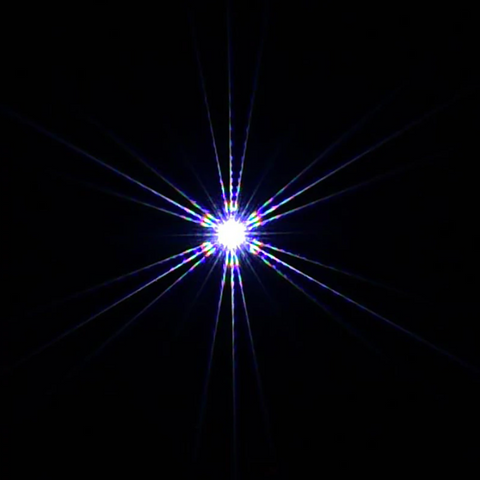
Who this guide is for: Schmidt-Cassegrain, Newtonian, and Ritchey-Chrétien owners. Refractor owners, your lens was collimated at the factory. Please put the screwdriver down and back away slowly. The Tri-Baht will still give you excellent focus.
STEP 1: Let your telescope cool down.
Set the scope up outside and wait until it matches the air temperature. A warm mirror bends starlight in ways that look exactly like bad collimation, and you'll spend an hour chasing a problem that isn't there. Larger scopes need longer. Go get a snack.
STEP 2: Rough collimation first.
The Tri-Baht is a fine-tuning tool, not a miracle worker. Newtonian owners: get close with your laser or Cheshire first. SCT owners: defocus a bright star and get the shadow of the secondary roughly centered in the donut. If you skip this step, the diffraction patterns will be too far off to read.
STEP 3: Pick a bright star high in the sky.
Something bright, and ideally not near the horizon where the atmosphere turns everything into soup. Center it in your field of view. Keep it centered for the rest of this guide. It will try to wander off. That's what stars do.
STEP 4: Attach the mask and line it up with your collimation screws.
Rotate the mask so each of the three patterns lines up with one of your collimation screws. Now each screw mostly controls one pattern, which makes this a lot less like a Rubik's cube. A small piece of tape on the tube marking the right position will save you time next session.
STEP 5: Focus on one pattern.
Adjust focus until one pattern's center spike sits perfectly centered between its outer spikes. That's your reference pattern. Don't touch the focuser again until step 7.
STEP 6: Adjust the other two patterns with your collimation screws.
Make small adjustments to the screws for the other two patterns until their center spikes are centered too. Small means small, a fraction of a turn at a time.
- SCT owners: you'll be adjusting the secondary mirror screws. Each tweak nudges the star off-center, so re-center it after every adjustment. And never loosen all three secondary screws at once, unless you'd like to hear your secondary mirror rattling around inside the tube.
- Newtonian owners: at this stage, adjust only the primary mirror screws.
STEP 7: Refocus and repeat.
Touch up the focus, then check all three patterns again. Repeat steps 5 and 6 until all three center spikes are centered at the same focus position. When they are, you're collimated and focused at the same time.
STEP 8: Remove the mask.
Seriously. Remove the mask.
STEP 9: Repeat step 8.
Troubleshooting
The center spike won't sit still. That's atmospheric seeing, not your telescope. Use short exposures on your camera and judge where the spike sits on average.
The patterns won't come together no matter what I do. Check your camera and focuser for tilt. A tilted imaging train can look a lot like bad collimation, and no amount of mirror adjustment will fix it.
A star is moving across the field in a zigzag pattern. That is not a collimation problem. Please report it to the Astronomer's Cabal and resume your session.
How often should I collimate?
Newtonians tend to shift during transport, so a quick check at the start of each session is a good habit. SCTs hold collimation longer but drift over time. The nice part about the Tri-Baht is that the check takes about as long as focusing, because it is focusing.
Ready to try it? Get the High Precision Tri-Bahtinov Mask, sized for your scope. New to focus masks? Start with How to Use a Bahtinov Mask or How to Focus on the Stars at Night. Be sure to Like and Follow Johannes Scientific on Facebook for more!