You did everything right. Tripod, dark sky, clear night. You cranked the focus ring all the way to the ∞ symbol, because that's what it's there for, right? Then you got home, opened the photos, and every star looked like a tiny fuzzy cotton ball.
Welcome to the club. The infinity mark on your lens is a suggestion, like the speed limit on I-10.
Why it happens
Your lens focuses past infinity on purpose. Most modern autofocus lenses are built to turn a little beyond infinity. That extra travel gives the autofocus motor room to work and makes sure the lens can still reach infinity when temperature or manufacturing tolerances shift things slightly. The downside: when you turn the ring to the hard stop, you're not at infinity. You're past it.
The mark itself is approximate. The ∞ on the distance scale is printed close to infinity, not exactly on it. Close enough for a mountain at noon. Not close enough for a star, which is the least forgiving focus target in the universe.
Temperature moves it. Lens barrels and glass expand and contract as the night cools. True infinity at 9 PM may not be true infinity at midnight.
Adapters and filters move it too. Using an adapter to mount a lens on a different camera, or adding a filter, can shift where infinity lands on the focus ring.
Zoom lenses can shift when you zoom. Many zooms change focus slightly as you change focal length. Always zoom first, then focus.
How to find true infinity
STEP 1: Switch to manual focus.
Autofocus in the dark is mostly a lens hunting for something it will never find.
STEP 2: Point at a bright star.
The brightest one you can find. Planets work too.
STEP 3: Turn on live view and zoom in on the star.
Use your camera's digital magnification, as far as it goes.
STEP 4: Get close by eye.
Back off from the hard stop and turn slowly until the star looks as small as you can get it.
STEP 5: Attach your Bahtinov mask.
You'll see three diffraction spikes.
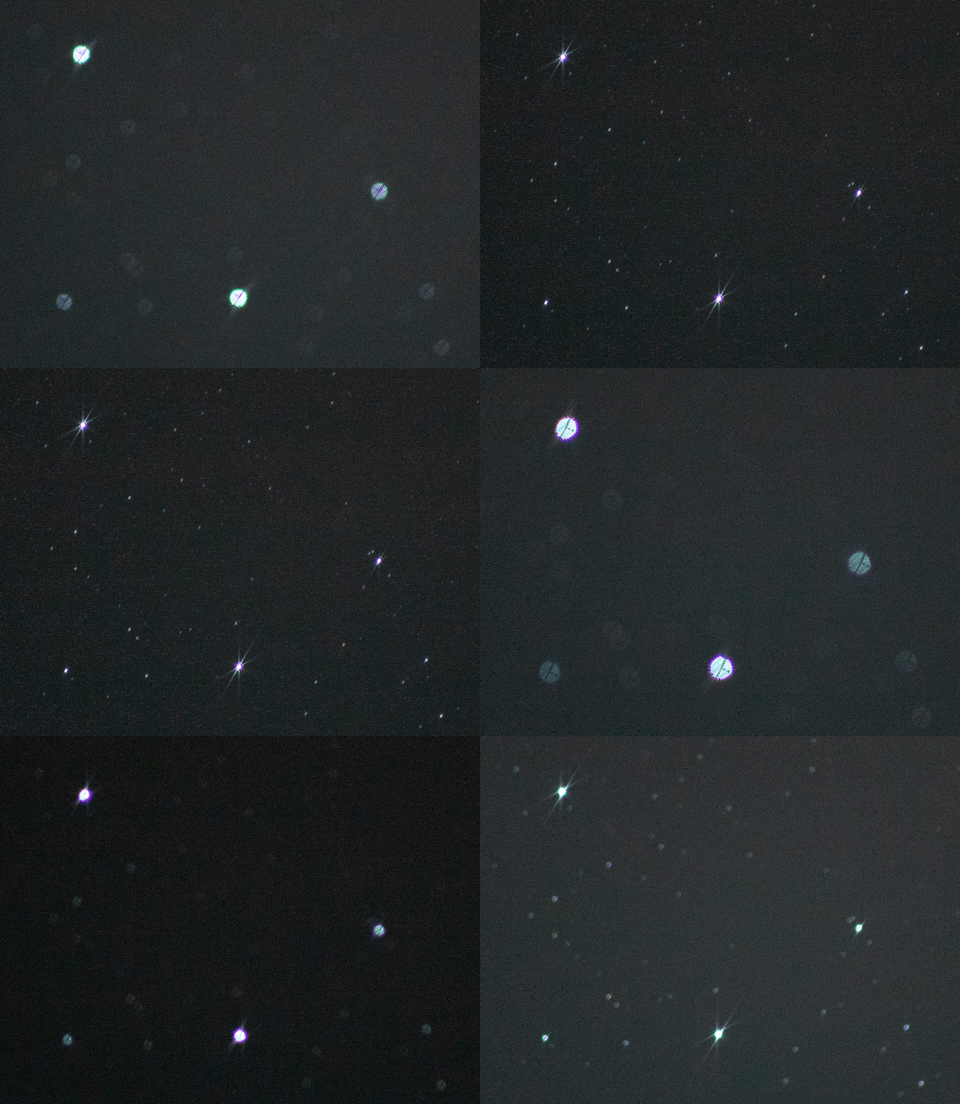
STEP 6: Adjust focus until the middle spike sits perfectly centered between the other two.
That's true infinity. Not the mark. Not the hard stop. Right there.
STEP 7: Remove the mask.
Gently. Without bumping the focus ring.
STEP 8: Tape the focus ring.
A small piece of gaffer tape keeps it from drifting when you inevitably brush against it in the dark.
STEP 9: Repeat step 7.
Every year, someone shoots an entire night through the mask. Don't be that someone.
Can I just mark the spot and skip all this next time?
You can mark it as a starting point, and it'll get you close. But because temperature, filters, and adapters all shift it, true infinity on Tuesday may not be true infinity on Saturday. A quick mask check takes less than a minute, and blurry stars are forever.
Which mask do I need?
For most camera lenses, our clip-on Bahtinov Mask or Carbon Fiber Bahtinov Mask. If your lens has a 77 or 82 mm filter thread, the Kase Bright Star snaps on magnetically. Not sure about sizing? See How to Choose the Right Bahtinov Mask Size.
Be sure to Like and Follow Johannes Scientific on Facebook for more!